News & updates News & updates
Why pilates is the missing link in your strength training
In my world as a physiotherapist and Pilates instructor, I often see two separate "camps" of movement: the heavy lifters in the gym and the dedicated movers on the reformer. But I truly believe these two modalities shouldn't just co-exist; they should be a perfect, hybrid pair.
While we know that strength training is incredible for building bone density and muscle mass—especially as we navigate changes like menopause—it is only as effective as the foundations it’s built upon. This is where Pilates becomes integral. It’s so much more than “a few pulses.” It is the ultimate tool for refining your body awareness, biomechanics, and coordination that can help you to lift heavier, and with greater intention.
1. Building the Map: Body Awareness
Before we can add external load, we must understand how to move our own bodies. Pilates teaches you to find the "quiet" muscles—the deep stabilisers that often get drowned out by larger muscle groups during a heavy squat or deadlift.
By practicing movements in a lower-load environment, you start to build a "body map". You learn to feel exactly where your pelvis is in space or how to slightly adjust your foot position to gauge greater connection with hamstrings. When you transition back to the weight rack, that heightened awareness remains, ensuring that every rep is purposeful rather than just about "getting the weight up".
2. Mastering the Machine: Biomechanics
I believe there are five movement patterns for life: the squat, hinge, four-point kneeling, rotation, and balance. We perform these movement patterns every single day. The Pilates repertoire (or exercises) captures almost all five of these patterns.
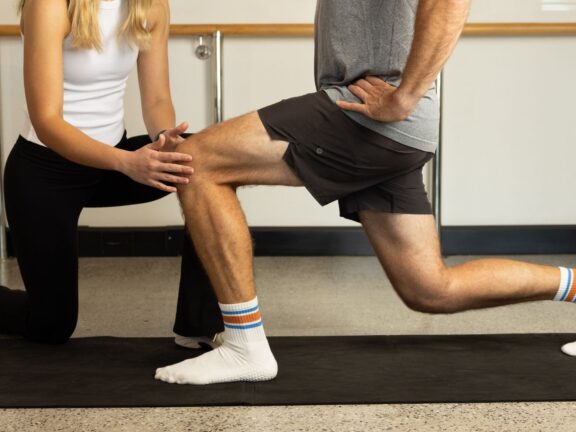
For example, using the reformer to practice a lunge series with specific spring resistance allows you to focus on alignment and feel, without the immediate challenge of a heavy barbell. We use the principles of Pilates, control, precision and breath, to first teach you how to stabilise and connect to your muscles. This then sets the stage for muscular strength and power later. Your biomechanics are refined through Pilates, optimising your movement patterns in your strength training, which helps you become more efficient with your lifts.
3. The Engine Room: The Power of Breath
If biomechanics are the "hardware," breath is the "software" that runs the system. In Pilates, your powerhouse (your deep core including your diaphragm, pelvic floor, transverse abdominis and multifidus) is key to create a deep connection to the movement and provide internal support.
Understanding how to coordinate your breath with effort is a game-changer for strength training. It helps manage the physical stress of a lift and ensures that your deep core is supporting your movement from the inside out. When you learn the foundations of breathing with your diaphragm, you will find that this can help to power those heavy lifts or complex movement patterns.
The Hybrid Approach
As a physiotherapist and Pilates instructor, my teaching style is a fusion of traditional Pilates and functional resistance training principles. Whether it’s manipulating tempo to increase time under tension or selecting specific springs for power, the goal is the same: lay down great movement foundations, challenge your strength and power, and to keep you moving, pain-free and functional for life.
Let’s stop thinking that Strength training and Pilates can’t co-exist. Let's use Pilates to lay the foundations of awareness and control, so that when we do pick up the weights, we are doing so with a body that understands the movement patterns and can be challenged!