News & updates News & updates
Forget the Ice Pack: Why Your Injuries Actually Need "PEACE & LOVE"
If you grew up playing sports or have ever dealt with a sprained ankle, you probably know the golden rule of injury first aid by heart: RICE (Rest, Ice, Compression, Elevation).
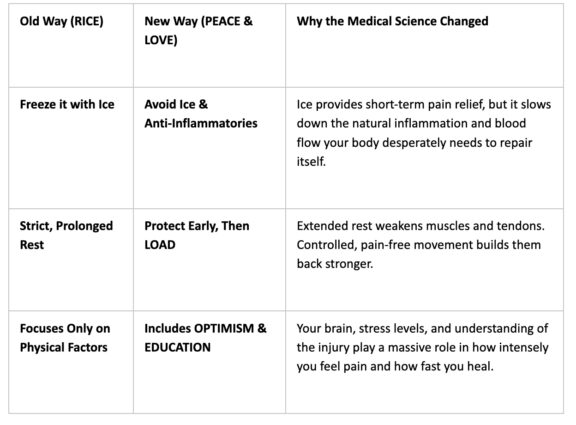
For nearly forty years, we’ve been throwing ice packs on every bump and bruise. But sports medicine has evolved dramatically. Today, clinicians are moving away from ice as the initial management of injuries and are instead advocating for a much warmer approach: PEACE & LOVE (Dubois & Esculier, 2020).
This contemporary framework covers the full lifecycle of an injury—moving beyond short-term damage control to guide you through complete recovery. Here is how you can give your next minor soft-tissue injury the care it actually needs.
🛑 Part 1: The First 3 Days (Give It Some PEACE)
Immediately after a sprain or strain, your goal is short-term damage control.
- P for Protect: Unload or restrict movement for the first 1 to 3 days to prevent further damage. However, keep total rest to a minimum—prolonged rest actually weakens tissue strength.
- E for Elevate: Keep the injured limb elevated higher than your heart to help fluid flow out of the tissue.
- A for Avoid Anti-Inflammatory Modalities: Inflammation is not the enemy—it is your body's natural construction crew sent to repair damaged tissue. Anti-inflammatory medications (like ibuprofen/neurofen) or applying ice can actually disrupt this natural process and delay long-term healing (Dubois & Esculier, 2020).
- C for Compress: Use taping or bandages to limit swelling which helps keep the joint comfortable and supported.
- E for Educate: This is where your physiotherapist plays an important role early in your recovery. Your physiotherapist will perform an assessment to determine the exact injury and provide you with a prognosis, they can also provide you with a referral for any scans that might be needed. The benefits of an active approach to recovery are well established, your physiotherapist will provide you with a graded approach to movement and equip you with the information that you need to continue to manage your injury.
🏃♂️ Part 2: The Days After (Give It Some LOVE)
Once the initial few days have passed, your soft tissues are ready for a different kind of care. It's time for LOVE:
- L for Load: Movement is medicine. As soon as your symptoms allow, you should gradually introduce mechanical stress and weight back onto the area. Optimal loading promotes tissue repair and builds tolerance back up in your muscles, tendons and ligaments.
- O for Optimism: Your mindset matters. Psychological factors like fear, depression, or catastrophising can actually act as physical barriers to your recovery (Dubois & Esculier, 2020). Approaching your recovery with realistic, positive expectations directly correlates with better healing outcomes (Briet et al., 2016).
- V for Vascularisation: Cardiovascular activity is a cornerstone of musculoskeletal healing. Starting pain-free aerobic exercise just a few days post-injury boosts motivation and pumps nutrient-rich blood straight to the injured structure to accelerate repair (Dubois & Esculier, 2020).
- E for Exercise: Strong evidence supports physical exercise to restore your mobility, strength, and balance after an injury (Dubois & Esculier, 2020). Doing proper exercises ensures you don't just feel better today, but you actively prevent the injury from happening again down the road.
🔄 At-A-Glance: Out With the Old, In With the New
References:
Dubois, B., & Esculier, J.F. (2020). Soft-tissue injuries simply need PEACE and LOVE. British Journal of Sports Medicine, 54(2),72–73
Briet, J.P., Houwert, R.M., Hageman, M., et al. (2016). Factors associated with pain intensity and physical limitations after lateral ankle sprains. Injury, 47, 2565–9